



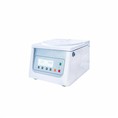


Hey there! If you're in the market for a centrifuge or just curious about how these nifty machines work, you've come to the right place. I'm a supplier of centrifuges, and I'm here to break down the principle of a centrifuge in a way that's easy to understand.
So, what exactly is a centrifuge? Well, think of it as a super - fast spinning device. At its core, a centrifuge uses the power of centrifugal force to separate substances of different densities. You know how when you're in a car going around a sharp turn, you feel pushed to the side? That's a bit like centrifugal force. In a centrifuge, we use this force to separate mixtures.
Let's start with the basic components of a centrifuge. There's the motor, which is the powerhouse of the machine. It's what makes the whole thing spin. Then there's the rotor. The rotor is like a little platform where you put your samples. It's attached to the motor, and when the motor starts spinning, the rotor spins too. And of course, there are the tubes or containers where you put the mixtures you want to separate.
Now, let's get into how it all works. When you put a mixture into the tubes and place them in the rotor, and then start the centrifuge, the motor makes the rotor spin at really high speeds. As it spins, the centrifugal force comes into play. Substances with higher densities are pushed to the outer part of the tube, while substances with lower densities stay closer to the center.


For example, let's say you have a sample of blood in a tube. Blood is made up of different components like red blood cells, white blood cells, and plasma. Red blood cells are the densest, so when you spin the blood in a centrifuge, the red blood cells will settle at the bottom of the tube. The white blood cells, which are a bit less dense, will form a layer on top of the red blood cells. And the plasma, which is the least dense, will be at the very top.
There are different types of centrifuges, each designed for specific purposes. One type is the PCR Centrifuges. These are used in PCR (Polymerase Chain Reaction) laboratories. PCR is a technique used to amplify small segments of DNA. PCR centrifuges are designed to handle small volumes of samples with high precision. They're often used to spin down reagents and samples in PCR tubes, making sure everything is well - mixed and settled before the PCR process begins.
Another important type is the Biosafety Centrifuges. These are crucial in laboratories where there's a risk of dealing with hazardous biological materials. Biosafety centrifuges are equipped with special features to prevent the release of aerosols that could contain dangerous pathogens. They have sealed rotors and air - filtration systems to ensure the safety of the laboratory personnel.
The speed of a centrifuge is measured in revolutions per minute (RPM) or relative centrifugal force (RCF). RPM tells you how many times the rotor spins around in one minute. RCF, on the other hand, is a measure of the actual centrifugal force acting on the samples. RCF takes into account the radius of the rotor and the RPM. Different applications require different speeds. For example, separating large particles might only need a relatively low speed, while separating very small particles or molecules might require extremely high speeds.
When choosing a centrifuge, there are a few things to consider. First, you need to think about the volume of the samples you'll be working with. If you're dealing with small volumes, a microcentrifuge might be the best choice. These are great for PCR and other molecular biology applications. If you need to process larger volumes, you'll want a floor - standing or benchtop centrifuge with a larger rotor capacity.
Another factor is the speed and RCF requirements. Make sure the centrifuge you choose can reach the speeds you need for your specific applications. Also, consider the rotor options. Different rotors can hold different numbers and sizes of tubes, so pick one that suits your sample containers.
Maintenance is also important. Regular cleaning and calibration of the centrifuge are necessary to ensure accurate and reliable results. You should also check the motor, rotor, and other components for any signs of wear and tear.
As a centrifuge supplier, I know how important it is to have a high - quality centrifuge that meets your needs. Whether you're a researcher in a big - name laboratory or a small - scale biotech startup, having the right centrifuge can make a huge difference in your work.
If you're interested in learning more about our centrifuges or are thinking about making a purchase, I'd love to have a chat with you. We can discuss your specific requirements and find the perfect centrifuge for your laboratory. Don't hesitate to reach out and start a conversation about your centrifuge needs.
In conclusion, centrifuges are amazing machines that use the principle of centrifugal force to separate substances of different densities. They come in various types and sizes, each tailored to specific applications. Whether it's for PCR, biosafety, or other laboratory work, there's a centrifuge out there for you.
References
- Alberts, B., Johnson, A., Lewis, J., Raff, M., Roberts, K., & Walter, P. (2002). Molecular Biology of the Cell. Garland Science.
- Sambrook, J., & Russell, D. W. (2001). Molecular Cloning: A Laboratory Manual. Cold Spring Harbor Laboratory Press.