


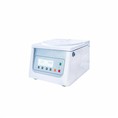

Hey there! As a supplier of centrifuges, I've had a front - row seat to the fascinating world of separation processes. One question that comes up time and time again is: What is the impact of centrifuge speed on separation efficiency? Let's dig into this topic and find out.
First off, let's understand the basic principle of a centrifuge. A centrifuge works by spinning samples at high speeds, creating a centrifugal force. This force pushes the components of a sample outward based on their density. Heavier components move towards the outer edge of the centrifuge tube, while lighter ones stay closer to the center. It's like a mini - version of a gravitational field, but much stronger.
Now, when it comes to the impact of speed on separation efficiency, speed is a game - changer. Higher centrifuge speeds generally mean greater centrifugal force. And with more force, the separation of different components in a sample happens more quickly and more completely.
Let's say you're working with a mixture of blood components. At a low centrifuge speed, you might only get a partial separation of red blood cells, white blood cells, and plasma. The lighter components might not be pushed far enough away from the heavier ones, and you end up with a somewhat muddled separation. But crank up the speed, and the centrifugal force becomes strong enough to clearly separate these components into distinct layers. You can see a clear boundary between the red blood cells at the bottom, the buffy coat (containing white blood cells and platelets) in the middle, and the plasma at the top.
For our Lab Centrifuge Machine, the ability to adjust the speed precisely is a huge advantage. In a laboratory setting, researchers often deal with a wide variety of samples, each requiring a different level of separation. Some samples might be very delicate and need a lower speed to avoid damage, while others can handle a higher speed for a more efficient separation.
In the medical field, Medical Centrifuge speed is crucial for accurate diagnoses. For example, in blood testing, a proper separation of blood components is essential. If the centrifuge speed is too low, the results might be inaccurate, leading to misdiagnoses. On the other hand, if the speed is too high, it could damage the cells, also affecting the test results. So, finding the right speed is like walking a tightrope.
Another area where centrifuge speed matters is in platelet - rich plasma (PRP) therapy. PRP Centrifuges are designed to separate platelets from other blood components. The quality of the PRP, which is used for various medical and aesthetic treatments, depends on the centrifuge speed. A specific speed is required to concentrate the platelets effectively without damaging them. If the speed is off, the PRP might not have the right concentration of platelets, reducing its effectiveness.


However, it's not all about going as fast as possible. There are some downsides to very high centrifuge speeds. One of the main issues is heat generation. As the centrifuge spins at high speeds, friction is created, which can cause the temperature inside the centrifuge chamber to rise. This heat can be harmful to sensitive samples, such as biological cells. To counter this, modern centrifuges are equipped with cooling systems. But still, it's something to keep in mind when choosing the right speed.
Another potential problem with high speeds is the mechanical stress on the centrifuge itself. The faster the rotation, the more stress is placed on the motor, the rotor, and other components. Over time, this can lead to wear and tear, reducing the lifespan of the centrifuge. That's why it's important to use the centrifuge within its recommended speed limits.
So, how do you determine the right centrifuge speed for your specific needs? Well, it depends on several factors. The type of sample is the most obvious one. As I mentioned earlier, delicate samples need lower speeds, while more robust samples can handle higher speeds. The density difference between the components of the sample also plays a role. If the components have a large density difference, a lower speed might be sufficient for separation. But if the density difference is small, a higher speed is usually required.
The volume of the sample is another factor. Larger volumes might need a higher speed to ensure proper separation throughout the entire sample. And of course, the time of centrifugation is related to the speed. A higher speed might allow for a shorter centrifugation time, while a lower speed might require a longer time to achieve the same level of separation.
In conclusion, centrifuge speed has a profound impact on separation efficiency. It can make the difference between a successful separation and a failed one. As a centrifuge supplier, we understand the importance of providing centrifuges that offer precise speed control. Our centrifuges are designed to meet the diverse needs of different industries, from laboratories to medical facilities.
If you're in the market for a centrifuge, whether it's a Lab Centrifuge Machine, a PRP Centrifuge, or a Medical Centrifuge, we're here to help. We can provide you with the right advice on choosing the centrifuge and setting the appropriate speed for your specific applications. Don't hesitate to reach out to us for more information or to start a procurement discussion.
References
- "Centrifugation: A Practical Approach" by Stephen B. Primrose.
- Journal articles on centrifuge technology and separation processes from scientific databases.